
Copyright © 2025 Nirav J. Patel, MD - All Rights Reserved.

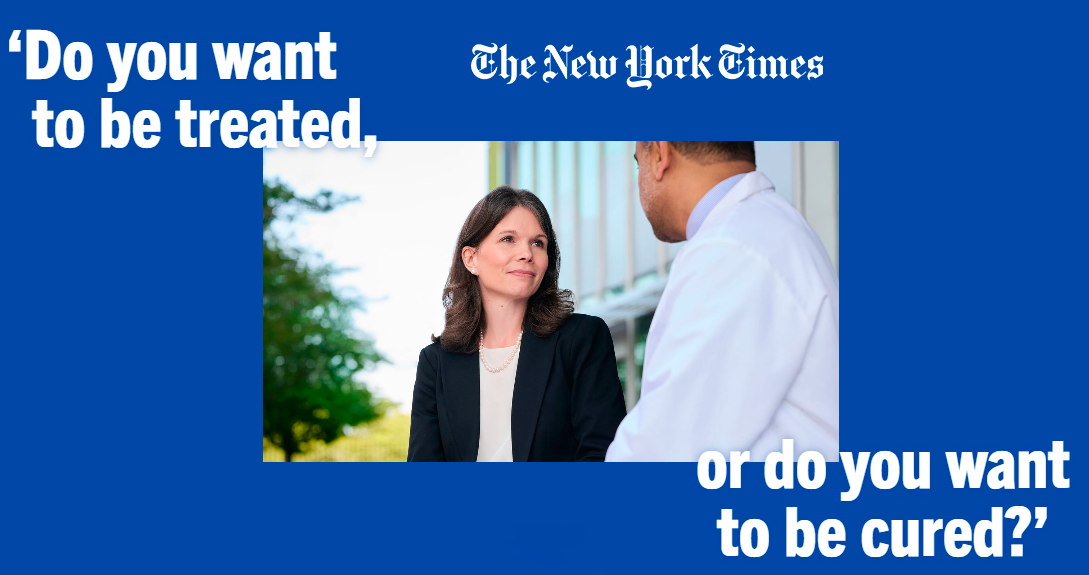
For Jenn Murff, it all started with headaches. Debilitating ones. At her family’s urging, she saw a local doctor in Virginia, who discovered a massive arteriovenous malformation, or AVM, a rare, tangled ball of misshapen blood vessels in her brain. Unbeknownst to Murff, she had the condition her entire life. But now, the vessel walls were starting to weaken, putting her at risk of a fatal rupture at any moment. Making matters worse, her AVM was so complex and so thoroughly obscured by critical brain tissue that doctor after doctor delivered the same devastating report: Her condition was inoperable.
Murff, to her credit, refused to give up. Over the next several months, she searched out dozens of specialists, some as far away as Germany, tracking them in an elaborate spreadsheet. Most rendered the same grim prognosis; a few, she recalls, didn’t bother to respond.
“No one would take a chance on me — no one,” she says, her voice carrying the weight of months spent in medical limbo.
“Everywhere I was denied care.”
Until, that is, she contacted Dr. Nirav Patel at Mass General Brigham’s Neuroscience Institute.
Dr. Patel, a leading neurosurgeon focused on AVMs, has devoted his life to treating this rare condition. “AVM offers something rare in medicine: the chance to cure — not just manage, cure,” he says. The new Mass General Brigham Neuroscience Institute brings together neurology, neurosurgery, pain management, psychiatry, rehabilitation and more, and conducts research in areas like neurotechnology and ALS in a collaborative environment. It enables physicians like Dr. Patel to take on complex cases, such as Murff’s, with multidisciplinary expertise.
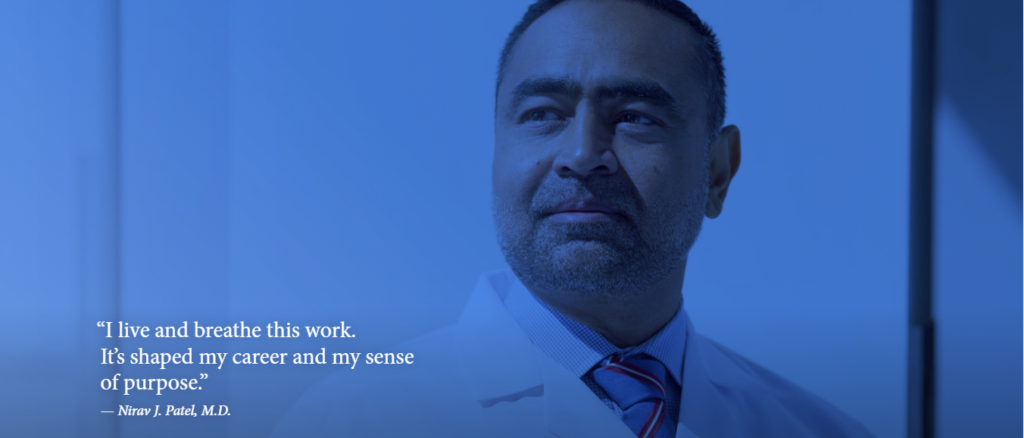
Dr. Patel personifies the ethos of the new institute. With every case, he says, he’s drawn to the technical challenge of treating the AVM itself and the opportunity to refine and improve his techniques while passing along what he learns to the next generation of surgeons. Just as he was once mentored by an AVM expert (Michael K. Morgan, M.D.), each year he trains fellows who will carry knowledge back to their own institutions, spreading high-level AVM care across the country and around the world. “I live and breathe this work,” he explains. “It’s shaped my career and my sense of purpose.”

Jenn Murff’s AVM was so complex and so obscured by brain tissue that doctor after doctor told her it was inoperable.
“Imagine a tangled ball of yarn — and a surgeon going millimeter by millimeter to remove it.” This is Murff’s description of the surgery, and Dr. Patel says it’s a good one. “AVMs are the hardest part of micro neurosurgery,” he adds. Though rare, affecting only 1 in 100,000 people, he says, “They’re the most common cause of hemorrhagic stroke in people under 42.”
To prepare for Murff’s surgery, Dr. Patel developed innovative techniques that pushed the boundaries of neurosurgical precision.
First, he gathered all the available information on Murff’s AVM, combing through CT scans, MRIs, fMRIs and angiograms. Dr. Patel used data from all those scans to create a precise 3D map of Murff’s brain and AVM, which he then used to plot his path through her neural tissue. During the surgery, Dr. Patel was able to view the map superimposed over Murff’s actual brain via augmented reality eyepieces, giving him a veritable “GPS” to follow during surgery.
For a case as complex as Murff’s, this proved to be an incredibly valuable tool. To remove her AVM, Dr. Patel would have to find each individual artery that fed it, close it off with tiny metal clips, and then carefully excise the entire mass, all while peering through a microscope.
His team included a neuromonitoring specialist as his “copilot.” An essential part of the AVM surgery, this neurologist gave him real-time feedback on how close he was to sensitive tissue to avoid damaging any active areas of the brain — something that had never been done to this detail before in AVM surgery. During the procedure, the specialist constantly stimulated sensitive areas of the brain and confirmed that they still functioned normally as Dr. Patel cut progressively through them.
Fortunately for Murff, Dr. Patel and his team had the experience and expertise to meet unseen challenges head-on. Murff ultimately needed more than just a few hours on the operating table; she went through three separate surgeries over the course of a week. On the eighth day after Dr. Patel made his first incision, Murff awoke in the neuro-ICU.

This angiogram shows one of the arteries (the thick line) feeding Murff’s AVM (the dense tangle in the upper right).
The unique approach that Dr. Patel and his colleagues take during surgery has made the Neuroscience Institute at Mass General Brigham a leading center for AVM care worldwide. There are only a handful of places across the globe that treat AVMs to begin with — and only Mass General Brigham uses Dr. Patel’s innovative mapping techniques. His approach has proven to be so novel, he’s published it in a medical journal article to help other neurosurgeons treat AVMs.
That sort of collaboration will be necessary to treat complex disorders like AVMs in the future. Although Murff’s surgery was successful, going under the knife was only the first stage of a comprehensive AVM treatment. Dr. Patel and his colleagues have spent years developing and training interdependent teams of ICU nurses, neurologists, radiologists and rehabilitation specialists, and each is essential to a successful AVM procedure. Dr. Patel explains:
After Murff’s surgery, neuroanesthesiologists maintained her in a medical coma for nearly eight days, while neuro-ICU nurses adjusted her blood pressure minute by minute, around the clock, to prevent strokes, hemorrhages and heart attacks as her arteries healed and returned to normal size. They offered emotional support as well, reassuring Murff’s husband as he sat by her bedside.

Neuro-ICU nurses like Amy Pollara adjusted Murff’s blood pressure minute by minute, around the clock, as her arteries healed and returned to normal size.
Today, Murff has returned to her normal life, running a Christian nonprofit from Virginia. But she still makes the journey to Mass General Brigham each year for CT scans and follow-up appointments. All of Dr. Patel’s patients do — not just for long-term monitoring, but for something more holistic.
Murff also continues to play an active role in helping other AVM patients find care. She regularly takes calls — often three a month — to support patients across the country in accessing treatment, sharing her story and encouraging them not to give up. Her advocacy is part of her personal mission, and her gratitude to Dr. Patel is steadfast. The woman who was once told by multiple specialists that her condition was hopeless now serves as living proof that the right team, the right technology and the right philosophy of care can overcome seemingly impossible odds.

“If I went anywhere else,” she says solemnly, “I would just not be alive.”
Photography by Tim Llewellyn.